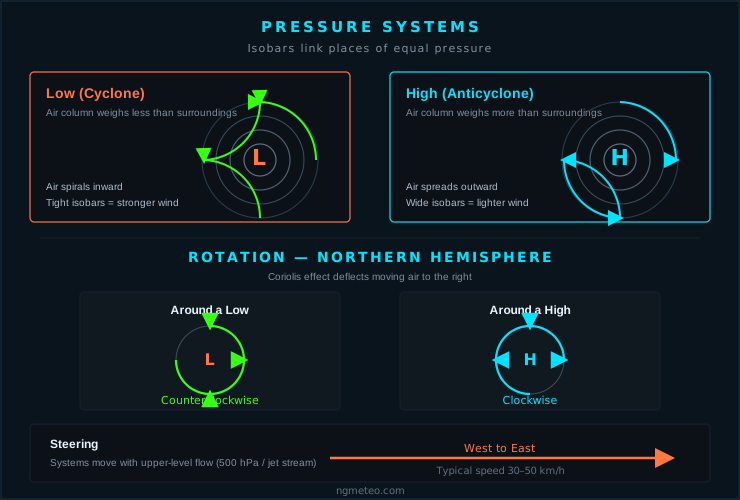
Atmospheric pressure is simply the weight of the column of air above a given point, and on a weather map it is drawn as isobars, lines joining places of equal pressure. A low, or cyclone, is a region where that column weighs less than its surroundings; a high, or anticyclone, is where it weighs more. Almost everything we call "weather", wind, fronts, clouds, rain, is the atmosphere's attempt to even that imbalance out, and the size, shape and life cycle of these systems is what forecast maps are really showing you.
How they form
Most mid-latitude lows are born along the boundary between warm and cold air masses, close to the polar jet stream. When the jet develops a wave, the air ahead of a fast-moving pocket within it, a "jet streak", spreads out faster aloft than it is replaced from below. That net removal of air lowers the surface pressure, and air starts spiralling in to fill the gap, a process called cyclogenesis. The temperature contrast across the boundary is the fuel: the sharper it is, the more explosively the low can deepen, sometimes dropping tens of hectopascals in a single day in a "bomb cyclone". Highs form the opposite way, where air aloft converges and sinks. Some, like the semi-permanent Azores High, are the descending branch of the tropical Hadley circulation; others are cold, dense air pooling over a continent in winter, or a "block" that forms when the jet stream buckles into a large, slow-moving loop and traps a high in place for days or weeks.
How they rotate
Earth's rotation deflects any moving air via the Coriolis effect, to the right of its motion in the Northern Hemisphere and to the left in the Southern Hemisphere. Around a low, the pressure gradient force pulls air inward toward the centre; Coriolis deflects that inward-moving air, and the balance between the two forces settles into a rotation that is counterclockwise in the Northern Hemisphere and clockwise in the Southern Hemisphere, with air spiralling slightly inward near the surface where friction breaks the balance. Around a high, air spreading outward from the centre is deflected the opposite way, producing clockwise rotation in the Northern Hemisphere and counterclockwise in the Southern Hemisphere. This is also why, in the Northern Hemisphere, standing with your back to the wind puts low pressure on your left.
How they move
Surface systems are largely carried along, or "steered," by the wind several kilometres above them, often approximated by the flow at 500 hPa or by the jet stream itself. In the mid-latitudes that flow is generally west to east, so most lows and highs migrate eastward, typically at 30 to 50 km/h, faster when the jet is strong. A low weakens and "occludes" once its cold front catches up with its warm front, cutting it off from the temperature contrast that powered it, after which it fills in and dissipates over a few days. Movement stalls almost completely when a blocking high parks itself in the path of the jet stream, forcing lows to swing around it and producing the long dry or wet spells that follow a block. You can watch this whole life cycle play out on the sea-level pressure and ensemble maps on ngmeteo.com, where the spacing of the isobars shows wind strength and the model runs show where a system is heading next.