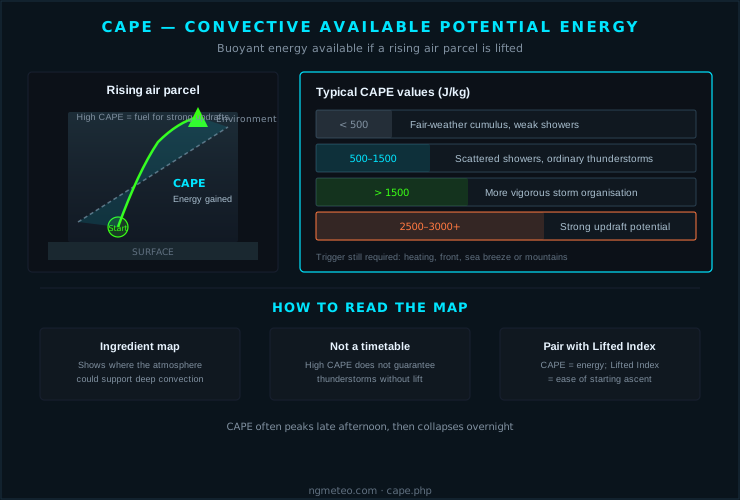
CAPE stands for Convective Available Potential Energy, a single number that estimates how much buoyant energy a rising parcel of air could gain if it were lifted through the atmosphere. On ngmeteo.com, the CAPE map colours regions where the model atmosphere is unstable enough to support deep convection. High CAPE does not guarantee thunderstorms; it means that if air is lifted to its trigger level, it has plenty of fuel to accelerate upward and build tall clouds. Low CAPE can still produce weather when other forces push air upward, but the updrafts are usually weaker and storms are less likely to become severe.
What CAPE values mean in practice
Values below about 500 J/kg often support only fair-weather cumulus or very weak showers. Between roughly 500 and 1500 J/kg, scattered showers and ordinary thunderstorms become plausible when a trigger is present. Above 1500 J/kg, storms can organise more vigorously, and values beyond 2500-3000 J/kg signal an environment with strong updraft potential, especially when combined with sufficient moisture and wind shear. CAPE is calculated from the temperature and humidity profile, so it can change sharply over a few tens of kilometres when dry and moist air masses meet. Always read CAPE as an ingredient map, not a timetable: you still need lift from fronts, sea breezes, mountains or daytime heating to release that energy.
CAPE versus Lifted Index
CAPE measures how energetic updrafts could become; the Lifted Index on ngmeteo.com measures how hard the atmosphere resists the first stages of lifting. A strongly negative Lifted Index usually aligns with high CAPE, but the two can disagree when the profile is complex, for example when a warm nose aloft caps growth even though mid-level instability looks impressive. Use CAPE on cape.php for a direct read of convective fuel across models such as GFS and ECMWF, then open lifted-index.php to see whether parcels can start rising easily from the surface or from an elevated layer. On days when CAPE is high but Lifted Index is only weakly unstable, storms may wait until peak afternoon heating or until a front provides the missing kick.
How to use CAPE maps well
Check the forecast time: CAPE often peaks in late afternoon when surface heating maximises instability, then collapses overnight. Compare runs and models; a broad CAPE maximum in every model is more concerning than an isolated spike in one run. Pair the CAPE layer with wind and precipitation maps on ngmeteo.com to see whether storms will be isolated air-mass cells or line up along a boundary. For outdoor planning, treat wide areas above about 1000 J/kg as a sign to monitor radar and short-range updates, not as a promise that your exact location will be hit. CAPE tells you how explosive the atmosphere could become once something starts the ascent.